I honestly have no idea how to write a blog post. Or keep up on a blog. So this will be an experiment unto itself. I don't mind writing though, I've kept a journal on and off for the last 10 years or so. Who knows? Maybe this will be good for me. I don't pretend to be the expert on anything, and this blog will likely be me attempting to make my ramblings appear logical and well-thought through, but if nothing else, it will be a compilation of my thoughts on bioethics. At times (like today's post) it will probably become deeply personal, but other posts will likely be more objective and focused on facts. All that being said, here goes nothing.
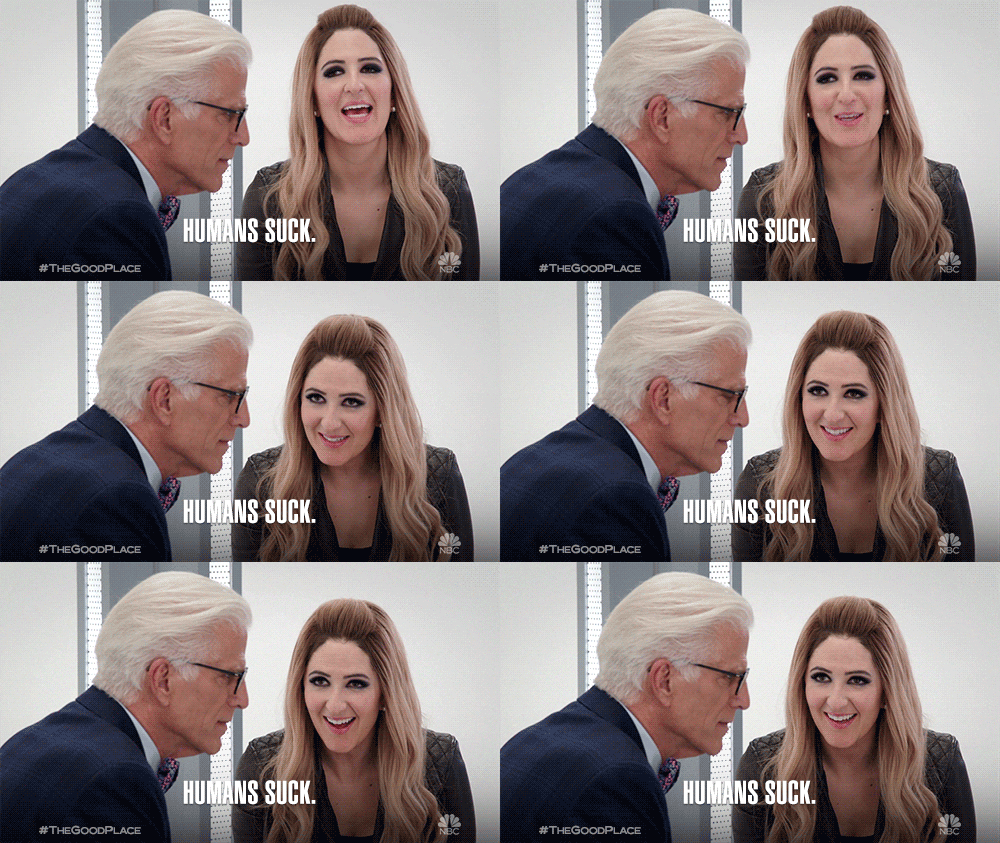
The name of this blog, "Bioethics: This is the Bad Place", comes directly from the fact that I spent the last two weeks of summer binge-watching NBC's "The Good Place". One of the main characters in that show is a moral philosophy professor, and much of the show's premise is centered around the characters striving to become better people based on the principles of ethics. For anyone who hasn't seen the show, it takes place in a version of the afterlife, where there is a Good Place and a Bad Place. One is Utopia, and the other is a place of endless torture. Bioethics is probably a combination of the two, but because it is my tired brain speaking tonight, we are in the Bad Place. So, welcome! Everything is fine.

When it comes to ethical questions or dilemmas, I often feel a little overwhelmed. Ethics...is it really worth all of the mental strain? As a scientist, I want a concrete and complete answer! There should be a right answer to every question, right? Apparently not. Sometimes there is no right answer, and sometimes there are multiple right answers. That's what makes ethics so difficult, is the fact that you can debate issues from both sides and make logic-based arguments to build any case.
But! There are issues with logic, too. These are often referred to as logical fallacies, or problems that come up in arguments and logic. There are endless everyday examples of logical fallacies; they're everywhere you look. A common logical error is appealing to feelings and upbringing. While feelings and background are important and can contribute to personal identity, emotions and personal feelings do not justify an ethical position.
For example, I was raised in a deeply religious family and the idea that people who were not religious were somehow "less than" was ingrained in my mind. In addition to this, I was taught that heterosexuality was "right" or "correct", and being gay was wrong. So, when I first had suspicions that I was gay, I did everything I could to suppress them. Because that wasn't the way I was raised, those thoughts/feelings/etc. were wrong, and therefore they couldn't exist or be right in any way. Over the last year or so, I've been struggling with religion as well. Double whammy. The cognitive dissonance at times for just one of these was difficult, but the combination of the two? Overwhelming. And in my mind, the logical pathway was to invalidate my own thoughts and feelings and focus on the feelings of my parents and my upbringing. Obviously this wasn't going to be comfortable or last long-term, especially for someone with a scientific mindset. If there was a problem, I am going to fix it! Or at least find a way for myself to exist with less dissonance. So, my life looks much different now than I ever expected it to. I have a girlfriend, I haven't been to church in months, and I'm happier than I've ever been. I've found a way through my personal upbringing, and while it has a lot to do with my personal feelings, my path to get to this point was based on actual facts, science, and the stories/experiences of others telling me that in no way do feelings equate logic. It could be argued here that I am replacing my parents' feelings and thoughts with my own, and while that is somewhat the case now that I have my feet under me, it definitely has not always been that way. It took extensive research and looking for solid logic for me to be able to see through the cloud that was created by my upbringing and feelings towards both anyone who wasn't actively religious and anything involving the LGBTQ+ community. That's the power of real logic (and also where this particular logical fallacy causes problems), that truth (or relative truth) can be found when there are reasons to justify a position instead of just feelings.
When it comes to bioethics, medical ethics, etc., personal beliefs and upbringing are often attached to the issues. IVF, abortion, adoption, physician-assisted death, and so many other issues are often argued over using nothing but personal beliefs, even though there are scientific resources available. When it comes to ethics and arguments, leave feelings out of it! Otherwise, this really would be the Bad Place.



Great post! I liked your flowing train of thought and how you tied it all together with personal experiences. I'm especially glad that you can be open about this struggle, since homosexuality will be one of the ethical issues brought up in this class--it sounds like you are very well prepared to bring logic into our discussions!
ReplyDeleteYES! I also ask the same questions. Why are there so many ethical dilemmas in science? I thought the point of science is that it is fact.
ReplyDeleteI also really like the layout of your blog!